How To Be A Parent

babyA young mother-to-be said with despair, “Only three weeks left to figure out how to be a mother!”

Oh, sweet new momma, I am still trying to figure that out fifteen years later.  I don’t mean to scare you, but this is the truth.

You will find your groove, yes, and figure out the basics like which type of diapers you prefer and where to find the sales on baby food.  But even if you become a mother twenty times over, uncertainty will remain.  Because just when you think you’ve got it figured out, the rules change, or the kids change, or you change.

You will make more mistakes than you’re willing to count.  Like, for instance, letting your six year old eat the party favor that you swear is white chocolate but is actually decorative soap.  (Yes, I did that.)

You will realize after several hundred of these foibles that a sense of humor is an essential item to pack in the diaper bag.  And it is precisely these times that earn you a notch in your parenting stick.  These falls from grace won’t guarantee that your next act will be seamless, but they will remind you that you can do the hard job of parenting AND live to tell about it.

If you are a ‘good’ parent you will never enjoy the smugness of certainty.  You will doubt every major and some minor decisions, feel guilty about others, and learn something new every day.  Early on you may learn that you shouldn’t play airplane with a baby who has just eaten lest he spit up in your mouth.  (That was husband, not me.)  Later, you may learn that you are not above ditching your child in a grocery store when she shouts, “Why is that lady so fat?”  And you will be anointed with humility when your little one declares aloud in church, “Mommy, you tooted!”

I wish my gift to you could be a key to the Parenting Answer Box.  But in my heart I know that if there was such a key to be given, it would ruin the whole experience.  If you had all the answers and didn’t crumble in despair once in a while, you’d never know the sweetness of vulnerability.  Just when you think you can’t go on, your little one reaches up to wipe a tear from your eye and says, “I wuv you, Mommy.  Pwease don’t cry.”  Renewed afresh, your heart fills up and you rise from the ashes.

When we stop banging on the door of certainty, demanding reprieve from the worry and fear of parenting, we realize that we are not alone.  Looking around, we find ourselves amidst the stories of millions of parents before us who stood exactly where we now stand, unable to break through the barrier of doubt.

There is no pot of gold at the end of the child-rearing rainbow.  And the treasure is not what you think it is.  It is not an honors student who never got arrested, never sassed his parents, and never skipped out on chores.  Nor is it a perfect parenting record that is envied by your fellow retirees.  The gift is simply this:  THE EXPERIENCE – good, bad, or otherwise.

Some day you will look back and wonder how you survived.  You will also continue to question your choices long after the children are grown.  But with any luck, you will have learned at least, to abandon blame and shame in favor of forgiveness and gratitude.  You dared to take on the title of parent in the name of love, despite your humongous fears, and did the best you could.

Make-Believe Manners

When a new friend invited my clan to dinner, I was excited – for five minutes – until I realized how unfit my three meal-time barbarians were for communal dining.

“Listen up!”  I announced in my most authoritative voice at dinner that night.  “This is serious.  We have a dinner invite.  We need work on manners!”

Not sharing my sense of urgency, kids returned their focus to animated banter, interrupting each other with mouths full of food and greasy hands gesticulating their point.  The color drained from my face and panic set in.  What will the neighbors think of us?  Two minutes of this animalistic feeding frenzy and they’ll send us packing with a ‘Don’t call us, we’ll call you.’

“That’s it!” I shouted. (Ironically matching their primal behavior.)  “You need to shape up.  Starting right now, you are all enrolled in Manners Boot Camp.”  My voice assumed a  drill sergeant tone.  “I want to see a fork in every hand.  No fingers on food.  Sit up straight.  Close your mouth when you eat…”  The list of instructions was lengthy.

The more I pestered, the worse it got.  Littlest one was paralyzed with confusion and teens indulged in a game of mockery, competing for Most Uncivilized.  “We know this stuff, Mom.  We just don’t do it at home because it doesn’t matter.”  Unconvinced, I soldiered on.

One night, son queried, “Will you be telling the neighbors that we’ve been practicing for a month just to eat at their house?” Not likely. “And neither will you,” I threatened.  “I’d like them to believe you’ve been groomed well since birth.”

As we pulled into the neighbor’s driveway I couldn’t help but give a final review of manners material. A collective symphony roared back at me, “WE KNOW! JUST STOP!”

Nervous smile plastered to face, I ushered my students to the front door where they exchanged cordiality seamlessly. Phase One – check.  Hostess took drink orders and received ‘pleases’ and ‘thank yous’ on cue. Phase Two – check.

Onward rolled the seamless evening with children playing and adults conversing.  Nary a warning glance was needed from Mom.  Dinner passed without incident….until dessert. By that point we had all relaxed enough to let our guard down and didn’t see Tom Foolery sneak in the back door.

I turned my head just in time to catch Prankster son mocking aristocracy with pinkie in air, pursed lips, and feigned British accent raving about the ‘delightful’ meal.  After dabbing the corners of his mouth with a napkin, he waved it ceremoniously in the air, fanning it out into a single sheet in order to be tucked into his shirt collar as a bib.

Teen daughter snickered, egging him on, and elbowed nine-year old Peach to join in the fun.  Unamused and preoccupied, Peach’s eyes grew wide as she declared with urgency, “I’m going to throw up!”

May Day, May Day!  We’re going down!

I shot a harsh glance at teen daughter which she understood immediately to mean ‘You and your brother regain control NOW!’  Daddy created a conversational diversion while I whisked pale-face off to the nearest bathroom.

“Did we pass?” asked a child when we arrived home.

“By the skin of your teeth.” I replied, and collapsed from exhaustion.

Silly isn’t it? This game of pretend we play.  ‘Look at me, a good mother, with good kids who have manners.’  Hah!  If the ruse could speak it would say something more accurate like, ‘look at me, pretending to have it all together.  Only a fool tries to cover up her family’s flaws. Everyone knows that real connection can only happen when people act as themselves, shortcomings and all.’

Yes, I know this, but press the right button and I am back in the third grade, wanting to be liked, wanting to be invited to the parties, and fearing that I’ll mess up my chances.  Truth is, that very fear is what could sabotage the deal. When we’re afraid to be who we are, afraid that we won’t be accepted, we act different. You know, like in an awkward way. That makes us, you know, like, stumble over our words and stuff.

The day after dinner, hosting friend dropped off our serving bowl with an encouraging note. Had a great time. Would love to have you over again soon.

Excellent.  Just not too soon, I thought.  I need time to recover from the stress of the first dinner.  Maybe next time we’ll try being ourselves and see how that goes.  How bad could it be?

Same Mother, Different Drama

scene1CRASH – SCENE 1, TAKE 1

Feb 17, 2012

When my thirteen year old son texted me from the ski slopes that he needed a new helmet after crashing, I handled myself very well – at first.  From my seat in the lodge, I calmly texted back a list of head injury symptoms to check for.  Instead of a return text, my cell phone rang.  It rang!

(In case you missed the significance of this, modern teenage practice dictates that only ‘old people’ use the phone.  Kids text.  Always.)

My worry meter escalated when I heard Beagle’s shaky voice asking me to pick him up on the other side of the mountain.  “I can’t see out of half my eye or hear out of my ear.”  Crap.  ‘At least he can talk and walk,’ I say to console myself.

Kindly First Aid people recommend a trip to the hospital. (Ya think?!)  They offer an ambulance for two, one seat for Beagle and one for the poor soul with the broken leg.  Strangely un-comforted by the thought of medical personnel escorting son, I opt to take him myself, unwilling as I am to let him out of my sight.

On the way to the hospital, I remain stoic on the outside and desperate on the inside.  I begin bargaining with God.  First, I offer my gratitude for life and health.  ‘Thank you, God, for sparing my son’s life in this accident.  I know you’ve got his back.  But I want to buy some extra insurance to cover him from the damage that has been done to his brain.  What can I give You?  How much will it cost me to insure my son’s well-being?  Take anything from me in exchange for his health.’

For a moment I actually believe this is possible – to sell myself to God in exchange for complete protection of my baby boy.  Prayers offered in earnest shift quickly to threats as doubts of my power to persuade God creep in.  I confront Him with my demands, desperate pleas, acts of contrition…in short, my LIFE.  If only He can give me a guarantee.

None is offered.  The swap shop isn’t doing business it seems.  I am left holding a heart full of fears, unsure where to turn.  So I turn back to Beagle, lying on the seat beside me, who is trying to block out the light from his overly-sensitive post-concussion eyes.

‘Be okay!’ I command silently.  ‘Please.’  I feel meek and helpless.

My son’s thirteen years flash before me – joys, sorrows, worries – always the worries.  It’s a cruel revelation when a parent realizes that the immense love she feels for her child is balanced in equal measure by fear for that child.  The more I dare to love, the more I risk the hurt.

A solid 48 hours passes before I begin to breathe freely.  Son was given clearance from the doctor to return home with caveats.  It’s not until Beagle starts fighting with a sister that fear loosens its vice grip on me – normalcy in any form is welcomed.

Beagle has all but forgotten the incident within the week.   But I, still shaken from my first head injury experience as a mother, continue to treat Beagle like a prized possession who narrowly escaped death.

Feeling that I should pay up on my answered prayers for Beagle’s recovery, I promise that I will never take a child’s health and well-being for granted again.

So much for promises…..

 

scene 2CRASH – SCENE 2, TAKE 1

February 17, 2013

(Same ski mountain, one year later)

My one day off from kid duty began uneventfully.  By mid-morning, with chores complete and tea brewed, I sat down to a novel. Simultaneously, my cell phone buzzed – a text.  I considered ignoring it but felt compelled by nothing more than curiosity to check the message.  It was from husband:

   HUSBAND: Teen daughter fell while snowboarding and bumped her head.  Probably has a concussion.

ME:  LOL.  Very funny.

It is exactly one year to the day of son’s incident.  Funny joke, husband. I’m not falling for it.

HUSBAND:  No joke.  Meet us at first aid.

A feeling rolls through me erupting in a howl.  Nooooooo! My one day off, ruined by another trip to the hospital! 

I kid you not – irritation is what I felt.  Surprising, and difficult to justify, I know.  As it turned out, I would spend the better part of a day trying to defend my lapse in compassion.

It wasn’t as though I was heartless.  On some level I knew that Principessa would be ok.  The tone of the text maybe.  Or mother’s intuition.  Or perhaps it was a deep-seated lesson learned from the experience with son last year – I could fall apart by worrying and praying my way through the next several hours of medical emergency (as I did with Beagle), or I could see it for what it likely was – another unfortunate, though not tragic, incident.  What couldn’t be anticipated was the level of chaos I was about to walk into.

Husband phoned to say that ski patrol had called an ambulance, advising that Principessa not be moved.  What?!  “Do NOT let her in that ambulance until I get there!”

Visions of insurance denials for expensive and unnecessary ambulance services flashed before me.  (In my defense, I had been apprised of the events and symptoms – which gives me about as much credibility as the average Grey’s Anatomy viewer, I know, but still.)

I stormed in, ready to take charge.  “What happened?!” I demanded.

Later, I learned that husband had predicted my entrance.  “In a few minutes a small Italian tornado will be coming.  That’s the mother.  We’ll all be okay, but brace yourself.”

By the time I showed up, Principessa was hysterical, trembling all over while an over-reactive medic held her head still and collared her.  He seemed surprised when I questioned his motives, requiring a justification for panicking my daughter.

Having done a quick assessment of my own, (I do have a level of medical training beyond that of the average mother,) I postulated that Principessa’s signs of shock were indicative of an anxiety attack caused by the drama, not by a spinal cord injury. If only I had gotten there sooner, I could have calmed her down and avoided this scene.

While husband and I weighed the options and potential risks of driving Principessa to the hospital ourselves, First Responders charged in with enough equipment to sink a ship – namely the one I was trying to captain.  It was too late, I couldn’t keep it afloat.

By the time we arrived at the hospital via flashing lights, Principessa had calmed sufficiently to bring her vital signs, and her senses, back to normal.  She laughed at my jokes and complained about how uncomfortable the backboard was. A CAT scan confirmed what I already knew – Principessa had an expensive headache.

I suppose this scene could have ended badly, in which case I wouldn’t be writing about it with self-deprecating humor.  But it didn’t, which gives me leave to assess the whole drama in contrast to the one that took place exactly one year ago.

During my recovery from trauma #1, it appears that I both gained and lost something of value.  On the positive side, now in possession of a thicker skin, I was able to keep my nerves in check when a child was injured.  Being desensitized can be a valuable asset.  The flip side is, I’m desensitized, which rendered me a bit harsh in a situation that called for compassion.  I all but attacked the very people who were trying to protect my daughter from the unknown, whilst I brazenly denied anything other than what I wanted to believe or suspected to be true.

All this to say that motherhood is Chaos with a capital C.  I could analyze it until I’m blue in the face, trying to glean scraps of clarity from the experience; I could promise to do better or different;  but no matter what, chaos will continue to sneak up behind me and change the rules, giving me yet another new experience to toy with.  All I can say is, God help me.  And God help the next kid who gets injured on my day off.
The Princess, The Witch, and The Door

photo credittruthluvr.blogspot.com

photo credit
truthluvr.blogspot.com


For years I’ve been trying to instill in my children the practice of knocking on a door before entering a room.  Two out of three have mastered the skill.  But Principessa, the oldest, struggles with this basic concept despite (or because of) my repetitive instruction and begging.

After a recent infraction, when daughter barged in on me in my bedroom (alone, thank goodness) I snapped.  In response to a reprimand, Principessa defiantly replied, “It’s no big deal, Mom.”

Really?  We’ll see about ‘no big deal.’

The next day, when Principessa was out of the house, I enlisted her brother’s help.  He had just woken at the crack of noontime and wasn’t feeling especially generous until I filled him in on my plan – to remove his sister’s bedroom door.  Suddenly devoid of morning stupor, Beagle popped out of his seat and ran to get the tool box.

When Principessa returned home and entered her doorless room, she, how should I say it?….Freaked Out.  In retrospect, I believe her reaction was a full-blown panic attack.  No privacy, too loud, too bright! Her concerns were numerous.

Principessa demanded that I return her door immediately.  She had ‘gotten the point.’  Silly girl.  Why would I put the door back so soon when I had gone to so much trouble to remove it?  Sorry, Love, lesson is not over.

For two days the family endured Principessa’s ranting.  Gradually, she began knocking on bedroom doors.  Unconvinced of her sincerity, I held out for the rest of the week just to be sure.

I knew it was time to rescind the consequence when Principessa entered the kitchen for a glass of milk.  In a show of the utmost respect, Principessa walked up to the refrigerator and knocked on its door.  “It’s not answering, Mom.  What should I do?”

At last!  We had moved past anger to acceptance and finally to humor.  Lesson complete.

I did the parent victory dance that day.  You know, the one where you celebrate the fact that you’ve managed to teach a lesson without losing your cool or getting sucked into the endless cycle of parent-child power struggle.  You’ve managed to use your grown-up skills without resorting to arguing with irrational young ‘uns.

One week later, Principessa failed (for the millionth time) to turn off her bedroom lights before leaving for the day.  I calmly explained that her next lesson would involve turning off power to her room.  Still smarting from her previous consequence, Principessa snapped to attention with apologies and promises and pleas to spare her the agony.  She knows I mean business.  But I fear that some lessons are best learned the hard way.  And I suspect I’ll be in the basement searching for the right fuse to pull before the end of the week.

Poor Principessa, she’ll probably want to take her door off so she can let in more light from the hallway.

A Sensitive Boy

Part I:  A Vicious Cycle

Once upon a time there was a sensitive boy.  He cried at the drop of a hat.  This annoyed the boy’s father who tried to toughen him up.  “Don’t be a sissy!” Dad said, which made the boy want to cry even more.  But he knew it wasn’t safe.  Instead, the boy choked back his feelings and hid them deep down in his belly where only he could feel the crying.

The crying worried mother, too.  “You’re too sensitive.” She said.  “You’ll get bullied.”  The boy believed her.  With practice, the boy became better at hiding his feelings.  But he didn’t stop feeling them.  Mother noticed that sometimes the boy’s face would turn red.  His lip would curl and tremble and his body would tense.  But he never cried again.

Over time, the boy would learn all sorts of tricks to hide his feelings.  He hid them so well, that even he couldn’t find them after a while.  One day, when the boy became a man, his wife would complain that he was devoid of emotion and unable to truly connect.  This confused the boy.

When the boy had a son of his own, he began to feel something stirring inside himself – something peculiar but familiar.  One day, the son got his feelings hurt and began to cry.  The boy, now a dad, wanted to cry too.  It hurt him to see his son hurting.  He remembered feeling that way when he was young.  But crying was wrong – dangerous even.  So the dad did what he thought was right and told the son to stop crying.  And the son did.

………

Part II – “My Son Is Too Sensitive”  – Is It True?

There is a story we tell ourselves about who we are and how it is.  We are too this.  Too that. Not enough of anything.  Every story is a variation of this shouldn’t be happening. Who would we be without that story?

Welcome to ‘The Work’ a la Byron Katie.  A process of inquiry.

I worry about my son because he’s too sensitive.  I want him to stop crying when his feelings are hurt.  And especially in public.  If he was tougher I wouldn’t worry about him being bullied.  I don’t want to see him hurting.  I don’t want him to get hurt because of the crying.

Belief:  My son will get hurt if he cries

  1. Is it true?   Yes
  2. Can you absolutely know that it’s true, that your son will get hurt if he cries?  No
  3.  How do you react, what happens, when you believe that thought? I get scared and angry and worried.  I try to toughen him up.  I try to help him not to feel.  I feel like it’s my job to change him.
  4.  Who would you be without the thought ‘my son will get hurt if he cries.’  I’d relax about him.  I’d comfort him instead of yell at him to stop crying when he’s hurting.  I’d be a parent who loves her sensitive son because I do love him so much.  I’d see how caring he is.  How he can sense what other people are feeling – which is a gift. I’d be able to love him and not worry about how sensitive he is. I’d support him.

Turn the thought around (to statements that are as true or truer): ‘My son will get hurt if he cries’

  1.  To the self:  I get hurt when he cries.’  (True.  I suffer with worry when I think of what his crying means.)
  2. To the opposite:  ‘My son won’t get hurt if he cries.’  (Might be true.  I don’t know how people will react.  Maybe he’ll meet with sympathy and understanding.)
  3.  To the other:  ‘I hurt my son when he cries.’  (True!  I disrespect his feelings.  I dishonor him when I tell him he shouldn’t feel the way he feels. I do what I’m afraid others will do to him – I hurt him when he cries!)

……

I realize I have two sons in my mind – the son I have and the son I think I want him to be.  The real one and the one I imagine to be better and safer.  I try to change him because there’s fear inside that I don’t know what to do with.  When I question my thoughts and meet my fear, I see that in my desire to protect him, I am actually hurting him.  Where is the love in that?

I don’t have to change what I believe. But I can, and should, question it.   Because if I don’t challenge my thoughts, they plague me.  So I ask myself again, who would I be, who would he be, without these thoughts? Can I find one stress-free reason to keep my thoughts?  In the questioning, I begin to see that none of my thoughts are true.  On the other side of the questions is freedom – for both of us.

It turns out, the world is perfect.  It’s what I think about the world that needs work.


The Perfect Post

(image credit Lama Jigme)

(image credit Lama Jigme)

I’ve been accused of appearing perfect.  BA-HA-HA-HA! (Excuse me while I ROFLMAO.)

It seems that this alleged perfection of mine can be intimidating.  This concerns me on several levels.  Primarily because if I’m supposed to be this ‘perfect’ person,  I’d like to enjoy it.  Perfection must have a benefits package that includes perks like flawless fingernails and the ability to walk gracefully in stiletto heels – neither of which I currently possess.  (Point me to Human Resources;  I’ve been gypped.)

The idea of my perfection is as absurd a notion as the misconception that my children eat liver.  It’s just not true.  All the same, I’ve amassed enough of these false accusations  that I must set the record straight.  Because I believe I’m being set up.  (I do hope someone from the FBI is reading this post.  I could use help debunking this conspiracy theory.)

You see, I am a perfectionist.  Or as I like to think of myself, a recovering not-good-enougher.  This is not to be mistaken for actual perfection.  Allow me to explain.

There is a demon inside of me who set up camp many, MANY, moons ago.  This demon believes it is protecting me from the pain of judgment and shame.  It thinks itself a shield – a very heavy one – that needs to be carried around constantly in order to earn approval.  Without this shield, I risk death.

Ok, that’s a little dramatic.  But to the hyper-sensitive little girl inside, not being enough is a death sentence.  And the world is a very scary place.

The irony is, the perfectionism shield scares people away.  It makes them defensive.  And they, too, prepare for a fight.  Only, they have swords.  And daggers that come out of their eyes – especially when I show up at the morning bus stop showered, groomed, and ready for the day after a 5 a.m. workout.

Sometimes they throw stones when they see what I eat – a wide array of healthy fare – because it makes them feel bad about their own choices.  So they try to hurt me without noticing that I’m already hurting from the dietary restrictions my body demands.

On occasion, they get their big guns out and attack where it hurts most – my parenting standards.  They see that I’ve written a book for tweens and equate that with a claim that I am a perfect parent. Deep down, beyond their own fear of being imperfect, they know – and I know – that there is no perfect parent.  But the wanting to be one, that does exist.  And it causes a whole mess of disappointment and misunderstanding.

If one really needs proof, I’m happy to pull out a file box of imperfections.  Just this week I’ve filled up an entire drawer with mistakes.  BIG ones like forgetting my BFF’s 40th birthday.  Ouch!  And medium ones like mistakenly ripping off daughter’s ski club ticket that was supposed to remain on her coat for the season.  (Then having to swallow my pride and admit that I am that parent that didn’t follow simple instructions.) And little mistakes like missing a doctor’s appointment.  All in one week!  In fact, I’ve noticed such a sudden increase in personal imperfection that I’m wondering if someone is in possession of a voodoo doll named Deb.  If you are, I beg you, leave her alone.  She needs a rest.

She, the perfectionist, works really hard at not wanting to be perfect.  She considers perfectionism an affliction, a cross she bears.  This cross is not one she would have chosen had she known how heavy it would be, or how many miles she’d have to carry it.  There are times it makes her fall to her knees and her loved ones have to peel her off the ground.  They might even offer to carry the cross for a while.  But the fact is, the cross belongs to her.  She will be crucified on it, I’m afraid.

For now, she walks on, practicing self-love, learning how to trust herself and to trust life.  Trying, and often failing, to show herself a bit of compassion.

Please, do not envy the perfectionist.  Do not mistakenly label her as perfect.  That label hurts more than you know.  She is not only wildly imperfect like the rest, but also acutely affected by imperfection, and incapable of embracing it in herself.

Most importantly – LISTEN UP – she doesn’t think she’s better than you.  Nor does she want you to feel bad about yourself.  She only wants to protect herself in a world that, long ago, taught her it wasn’t safe to make mistakes.

The Pep Talk

Beagle had a bad day.  An ‘I hate my life’ kind of day.  The grievances were numerous.  Each one packed only a small punch, but strung together they gained impact.

It started with attention-seeking for a minor injury which morphed into an excuse to skip football practice. Next, a complaint of boredom and some push-back against serving time on a grounding consequence.

At first I reacted with defiant conviction, employing the ‘tough it out’ message.  But when tears welled up and a thirteen year old voice started shaking, I backed off.  Clearly, Beagle’s complaints were a cover for a bigger issue.

With a little prodding the truth revealed itself – a personality conflict with a coach that became too big to contain in one young boy.  Now this, I could handle.  Dealing with difficult people is a challenge I relish. And I am all too willing to impart my expansive wisdom in the life skills department.  Teachable moments can be so gratifying!

After several minutes of listening to my monologue, Beagle patiently advised, “I don’t need a lecture, Mom.”

“I’m not lecturing!  I’m inspiring!” I clarified, and sent him off to practice with a ‘go get ’em, Tiger’ and a love punch.

When Beagle returned from practice, I held my breath, unsure of what to expect.  I tiptoed around trying to gauge his mood and waiting for him to speak first.  With satisfaction he said, “I felt some redemption at practice. Caught a forty yard pass. Twice. And looked like a hero.”

The corners of my mouth turned up.  Surely the catalyst for success was my inspirational talk.  Not wanting to steal Beagle’s thunder (but feeling pretty smug) I praised him for plowing through a challenging situation with character.

But I couldn’t hold back.  Assessing his lightheartedness, I deemed it safe to ask, “So, do you think the positive outcome of the night had anything to do with my pep talk?”

Beagle froze, fork in mid-air, and gazed at me askance.  I could almost hear his brain weighing possible responses.  He decided on this, “Mom, if it makes you feel good, then yes, it had everything to do with your pep talk.”  And he quietly returned to his dinner.

He’s too good to me, my Beagle.  And wise for a young man, having already learned to tell women what they want to hear.  At least I’ve imparted that valuable piece of wisdom!

Sibling Lovelry

When my son, AKA Beagle, was four years old, husband and I announced that baby number three was on the way.  “I want a brother,” Beagle announced with conviction, as if his wanting was enough to manifest a baby boy.  He already had an older sister so…..we broke the news gently.

“We do know what the baby is,” I admitted.  His face lit up with anticipation.  “It’s a girl.”  Instantaneously, Beagle’s head dropped with a thud onto the table in despair.  With face buried in forearm, he lay silent.  While older sister, AKA Principessa, danced in celebration, I attempted to explain to the top of Beagle’s head that we didn’t get to choose.

Silence.

I added sugar-coating like the fact that he would always have his own room as the as the only boy.

Silence.

I assured him that he’d be a great big brother.

Silence.

Then Beagle raised a single hand in the air, head still down, and solemnly replied, “I’ll be okay.”

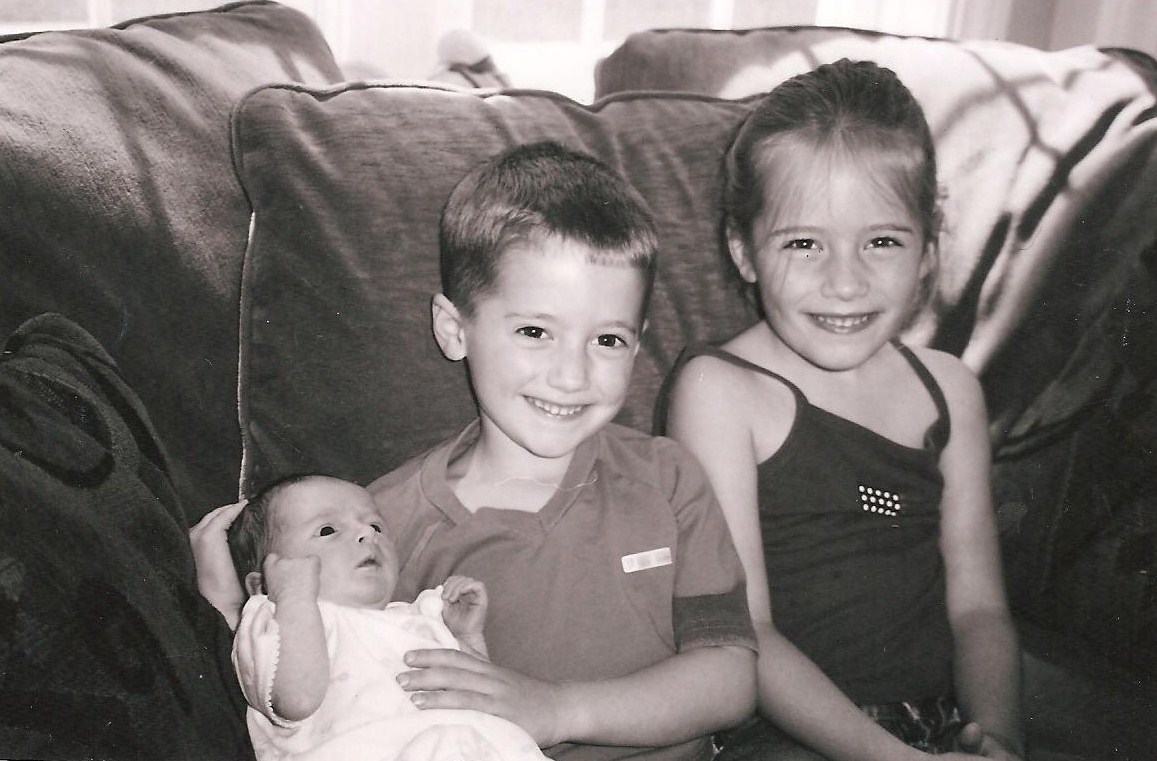
Beagle was more than okay.  This is a picture of him when Peach arrived.  Could he be any more smitten?

As it turned out, Beagle and Peach formed a close bond.  He adored his little sister and she him.  Eventually though, the novelty wore off and he went his merry boy way.  I feared that their lack of common interests would prohibit a close relationship between them.  But when Peach turned six and couldn’t ride a bike without training wheels, Beagle stepped in.

It was a casual summer day when Beagle marched in the kitchen and accused me of negligence.  “I can’t believe you haven’t taught Peach how to ride on two wheels yet.  She can’t start First Grade on training wheels!  Leave it to me.  I know what I’m doing.”

Staunchly determined, Beagle grabbed a fistful of lollipops for reinforcement and headed outside.  Honoring my promise not to interfere, I watched from the window.

Like a pro, doting older brother ran up and down the driveway holding the back of Peach’s bike while shouting out instructions and encouragement.  Within the hour, Peach was riding solo with big brother running alongside and cheering.

Beagle strutted back into the house, chest puffed up, and declared, “Mission accomplished.”

I was reminded of that favorite story today, three years later, when I sat poolside watching Beagle teach Peach how to dive.  With characteristic patience and sensitivity, big brother devoted his afternoon to imparting this new skill.  All the while he exchanged secret smiles with me, each of us enjoying the process.

These are the kinds of moments that make my mother heart swell with joy.  These are the shreds of hope that restrain me when I want to choke the next child who fights with a sibling.  I need these reminders from time to time to balance the sometimes excruciating task of establishing family harmony. Like, for instance, several weeks into summer vacation.

Today I decide that I can rest peacefully, knowing that no matter how much my little ones bicker and compete, they do love each other.  When the rubber meets the road, they travel together.

I suspect that when I’m old and gray, and my children are grown, they will continue to have their differences.  They may even try to involve me for peacekeeping.  And I will sit back in my rocking chair smiling at their sibling lovelry.

Habits Are Hard to Break

Habits are hard to break.  Especially the destructive ones.  If only they weren’t so satisfying.  Like thumb-sucking for example.  “It feels so good!  It’s so HARD to stop” explains a certain nine year old.  Yes, nine.

I distinctly remember how proud I was that Peach found her thumb, a way to self-soothe, at the advanced age of two weeks old.  I may have even danced a jig at the thought of dispensing with the customary ball and chain, AKA binky.  Thumbs are always there for you.  They can’t get lost or dropped on the floor of a public restroom or forgotten at home.  Smart baby girl.  Love a thumb-sucker.

That is, until she sucks her way into orthodontic danger zone.  Kindly orthodontist informed us that this habit, if continued long enough, could result in irreversible structural deviations.  In no uncertain terms he explained to Peach the dire need for her cooperation in the matter.

Peach has heard a similar spiel from concerned family members and has not been impressed.  But this time, as we exit the orthodontist office, she solemnly admits, “He was pretty convincing.”

We strike while the iron is hot.  Out come the star charts and verbal agreements and socks to cover sleeping hands.  Hard times ahead for Peach.  She’s tried jumping this hurdle before and managed only to fall over it.  Bravely, with renewed resolve, she agrees to try again.  Her forlorn eyes tell a sad story.  Her best friend, her ‘thumbly,’ must never enter her mouth again.  Laying her head on her pillow, she raises her mitts and wonders aloud, ‘What if….’

“Don’t go there.” I advise.  “Take it one step at a time.”  I remind little Braveheart of the many skills she possesses and the challenges she’s overcome.  “There is a muscle inside of you, the inner strength muscle, that has the power you need.  The more you exercise it, the stronger it gets.  The stronger it gets, the easier it is to resist a habit.”

I offer my full support.  But the fact remains, there is only one girl who can close this deal.  After arming her with all the strategies I can think of, I kiss Peach goodnight and exit the room with fingers crossed.

At the crack of dawn, elated nine-year old runs out of her room waving sock-covered hands proudly above her head.  “I did it!  Look, I left the socks on ALL night!”  With new-found confidence, she launches into a triumphant monologue that resembles an acceptance speech.

Peach prematurely tells her admiring audience how she conquered the demon thumb-sucking habit.  I listen with a ridiculous smile plastered on my face and enthusiastically join in daughter’s celebration.  She is flexing that inner strength muscle with conviction.  I’d swear she’s grown overnight.  She stands tall and proud and ready to take on the world.

“You know,” she observes, “Not sucking my thumb wasn’t that hard.  Once I put my mind to it, I was all set.”

Bingo, Baby!  Mind over matter.  (Now if Peach could set her mind to cleaning her room and flex the ‘I can do it’ attitude in the organization department, we’d really have cause to celebrate.)

It’s a bittersweet end to an era.  My baby is growing up.  She is crossing bridges under her own steam.  She’ll need me less now – now that she’s a habit-breaking champion.

I believe the theory that says a parent’s job is to put herself out of a job.  I’m all about teaching self-sufficiency and raising self-esteem.  Yet still, my heart tears a bit each time I surrender a piece of the best job I’ve ever had.  So I turn my advice on myself and flex my own inner strength muscle in order to summon the courage it takes to let my little bird fly a little farther away.

Playing Small

A friend, sitting by the community pool with several other mothers, listens with increasing irritation to their animated conversation which resembles a verbal contest.  The main theme: busyness.  The object of the game: one-upsmanship.   Who can claim the prize for the Most Overworked Mother?

Each mother in succession pipes in her list of parenting woes expecting sympathy, horror, or dare I say, admiration from the others.  The group serves as a collective listener though one is not convinced that they actually hear each other.  Rather, each is distractedly plotting her own strategy.

One woman, wearing busyness like a badge, pulls ahead in the game.  She has multiple children in multiple sports and activities.  None, of course, are grateful for what mother does to enhance their lives.  The conversation takes on a dramatic volume and pitch as this mother concludes with sweeping gestures to enhance her case.

Who will be crowned the winner?  Which poor, selfless, overworked mother has ‘it’ the worst?  Like a typical round of Monopoly, there is no end to this game.  The only real winner is the one who chooses not to play.  This is the mother who knows that complaining and blaming equal playing small.  This mother knows that an over-scheduled child does not make the schedule.  Mother does.

The pattern of giving too many yes’ and no enough no’s is one I’m familiar with.  In the blink of an eye, the family calendar fills to capacity and begins to bust at the seams, leaving mother in a puddle of exhaustion at the end of a day.  And always, though I forget sometimes, I am in control.

The desire to give children the world can obscure a mother’s judgment.  It can trick her into attempting to juggle flaming torches and spin plates on sticks while walking a tightrope.  When she tries this stunt and fails – because she will – mother may fall to the ground and, without thinking, blame her child for pushing her off the rope.  Silly mother.

Instead of egging her on with ooh’s and aah’s like a crowd at the circus, mother’s friends could say these words:

Get down here before you hurt yourself!  Your children need you in one piece.  You don’t have anything to prove.  There is no prize for scaling tall buildings in a single bound.  Your prize is here on the ground.  It is waiting for you to stop running around long enough to pick it up and hug it and tell it how much you love it.

 The prize will understand, eventually, if the love words include a ‘no’ here and there.  It may even thank you some day for setting limits in order to preserve sanity and closeness and family time.  At the very least, you will have prevailed in the Game of Life because you chose not to compete.  Instead of playing small, you kept your eye on the prize, your feet on the ground, and your heart in a grateful place.

Previous Older Entries Next Newer Entries