Helen Keller Could See

A blind man walks into a restaurant.  The maitre d’ says, “I’m sorry sir, dogs are not allowed in the restaurant.”  The blind man defends, “This is my guide dog.”  The maitre d’ replies, “You expect me to believe that a chihuahua is a guide dog?”  To which the blind man exclaims, “What?!  They gave me a chihuahua as a guide dog?!”

This is my favorite joke.  My children tease that it’s the only one I can remember.  This is true, but really I love it because of what it implies about human nature, and about the gift we call vision.  It leaves me thinking that vision may not be the prize we think it is.

I’ve been myopic since sixth grade.  By the time I reached high school I needed to wear glasses full-time.  I despised my limited eyesight, feeling vulnerable to ridicule and dependent on a pair of plastic frames for survival.  So scared and angry was I at not being able to see everything at all times, that I cursed God and my body for my handicap.  The advent of contact lenses provided some relief from the struggle.  But when repetitive eye infections plagued me during my senior year, and I was forced to resurrect the large, thick glasses FOR MY PROM, the venom returned.

I’ve made some peace with limited vision since then and have come to appreciate the availability of corrective lenses.   At times, I can even laugh about the predicament of low vision.   Like the morning my glasses fell off the bedside table.  The folly of trying to find the thing that helps you see when you need that very thing to see, cracks me up.

Giving up the search, I stumbled to the bathroom, hands on walls for guidance, to begin my morning routine.  After rubbing the sleep from my eyes and washing my face, I looked up to the mirror to asses the night’s damage.   Instead of the middle-aged, bags-under-the-eyes, acne-prone woman who usually greets me, was a…well…beauty.  Before me stood a healthy, trim, glossy-skinned goddess.  I could hardly believe my blurry eyes.

With regret, the irony hit me.  Seeing poorly made me see well.  I recall a meditation instructor guiding his students to look at their faces from the inside out.  At the time, I didn’t get it.  But today, standing half-naked and partially blind in front of a mirror, I see myself for the first time from the inside.  And I am perfect.  The realization makes me cry.

I mentally flip through a list of misguided grievances that have accumulated over years of ‘seeing’ myself.    How unfairly harsh I’ve been on my human form.  How many beliefs about my worthiness do I possess that are based on false processing through my eyes? Wayne Dyer says, “Change the way you look at things and the things you look at will change.” In the absence of detailed vision, I see the whole picture.

When my daughter was two years old, I scolded her for misbehaving.  Subsequently, I frowned at her.  She pointed her little finger at me and said, “No, Mommy.  Don’t see me that way!”  She’s right, of course.  I wasn’t just giving her ‘a look.’  I was judging her, seeing her in a way that reflected my unloving thoughts.  It’s the same disapproving look I’ve given myself in the mirror.

My thoughts drift to Helen Keller who said, “I can see, and that is why I can be happy, in what you call the dark, but which to me is golden.  I can see a God-made world, not a man-made world.” After awakening to the limitations of my own intact senses, I conclude that perhaps blindness exists to an even greater degree in those who believe they can see.

I’m over forty years old now, which means my eyes are too.  After years of failing to see at a distance, they are deciding that, heck, they don’t need to see anything up close, either.  And it’s okay.  Seeing is overrated.

“Everything has its wonders, even darkness and silence, and I learn whatever state I am in, therein, to be content.”  – Helen Keller.

The Sweetness of Clarity

Today I was blindsided by chaos.  I imagined it would be a mostly ordinary day – kids to school, Mom to work, and husband on a rare business trip.  Silly me.

The drama actually began late last night when teen daughter waged a war against chores and chicken for dinner and all things parent.  Poor husband sought consolation, “Can you believe her?! ”  To which I responded with my go-to justification, “She’s a teenager.”  When rational explanation fails, this single fact makes it all better.  Teenhood is not a permanent condition.  Doors were slammed, lights flicked off, and sleep was welcomed.  Tomorrow would be a new day……A day that began too early.  Midnight to be exact.

Like Cinderella who transformed at the stroke of midnight, dear son turned into a vomiting machine. This, as you fellow parents know, is a game changer.  Instantly, my day went from busy/manageable to crazy/juggling.

As it were, I was scheduled to drive my usually-bus-riding daughter and a friend to school for the Architecture Fair.  SHOOT!   This is the event that husband was supposed to attend to fulfill the ‘at least one parent should show support’ thesis.  But he is away on business which means I should go. But when? How?

The phone rings, breaking up the rapid-fire problem-solving in my head.  It is friend, wondering if we’ve forgotten her or are we just running late?  Scrambling to the car, bagel in one hand, trifold display in the other, we settle into a comfortably illegal pace on the highway when teen daughter exclaims (too hysterically) that the written portion of her project has been forgotten at home.  Would I go back and get it after dropping her off?

I gaze at the Heavens with a ‘You’re kidding me, right?’ look.  Is this level of chaos all in one day really necessary?  Daughter gives further instruction on the location of said paper.  It’s beside the computer which, by the way, “crashed when I was trying to print off another copy.”  Lovely.

I am torn.  Yes or no?  Go out of my way, taking more time than I have, in order to save my daughter?  Or help her to learn responsibility by suffering the consequences?  She was, after all, a beast last night.  She wasted valuable project preparation time with her tirades.  I’m not feeling especially generous toward her.  But there are other factors to consider too: a younger child in tow who needs to be at a different school momentarily, a son who clearly shouldn’t be left alone, a dance carpool commitment (of all weeks!) and oh yes, a job that is expecting me.  My mind is on a spinny ride at the amusement park and I want to get off.

When Chaos arrives like it has today, Clarity eludes me.  She loves a game of Hide and Seek.   Sometimes it’s easy to find Clarity.  She’s like a small child who hides in the same obvious spot every time she plays the game.  Other times she gets sneaky and hides somewhere in next week or next month – so far away that I have to give up searching for her, knowing that eventually she’ll return to me.  So I keep the door unlocked.

Today, Clarity jumps out at me from behind the phone.  Grandpa calls and would LOVE to drive  45 minutes to spend part of the day with a sick child so mother can take care of the rest of the world. Mercy abounds!

This one monumental gesture of kindness lights a spark in me.  My cold and confused heart warms from the gift it has received and it feels like giving too.  It feels like calling work to say that business is never more important than children.  It feels like fetching and delivering the forgotten school report.  It feels like completing the child chores that were left undone last night.  It feels like attending the Architecture Fair to support not only it’s own child, but the others whose parents didn’t hear their hearts today.

My heart is rewarded with immense gratitude in the form of bear hugs when I arrive back at teen daughter’s school.  It is further elated when it returns home from a brief stop at work to find that, without prompting, the dishwasher has been unloaded by the very same teenager.  The heart knows this path.  It gives generously and without expectation and ends up receiving.  The mind is not as smart.  It would have me judging and measuring out gifts, and calculating retribution.  I really should learn to consult my heart first.  It would save me, and my mind, a lot of trouble.

Fifty More Shades of Grey

Yes, reader, I’m one of the millions who has been swooped up by the curiosity storm that is Fifty Shades of Grey. And it has me thinking about, well, lots of things – many of which I dare not share here.  If you’re a self-described prude as my neighbor is, fear not, it’s not what you think.  This is not a shock-jock type of post.  Nor is it a literary review.  There are plenty of other forums exploring this cult-like explosion and what it means.  Which is why I want to ask, ‘What do you mean, what does it mean?

Does the book’s crazy-big popularity have to point to some dire deficit in womankind – or mankind? Do we really have to pull out the holier-than-thou judgment card?  Experts will have you questioning your motives, doubting your core stability, worrying over betraying a secret desire, and making excuses for why you did or did not enjoy the book.  The bottom line is this:  there are as many different acceptable reactions to Fifty Shades of Grey as there are, say, shades of grey.

Which brings me to my story.  It’s a very different story than the one referenced above.  It involves a seven-year old girl, a first-time mother, and a rainy day….

My daughter and I were driving along on the kind of day that makes me want to curl up under covers with a cup of hot tea and warm pajamas.  The rain came and went and threatened to return.  My daughter stared out the window blankly, sharing a similar distaste for the weather – I thought.  “I’m so glad we have color in the world,” she observed.  “I agree!  We need color on a dull day like this,”  I absent-mindedly replied.  Puzzled, my daughter disagreed, “No.  I was thinking how great it is that there are so many different shades of grey – the pavement, the clouds, the puddles….It’s beautiful!” 

‘Well, I’ll be a monkey’s uncle!  I’ve been schooled by a child,’ I thought. (One of many occasions.)  Here I was, lamenting the effect of the sky on my mood and wrongly presuming it was  universal sentiment.  In so doing, I might have conditioned one unprejudiced little girl to fall into the trap of mindlessness.  Thankfully, she dared to contradict an elder with her impartial view of beauty.

It’s been said that the whole world can be seen clearly through the eyes of a child.  Since that momentous day, I’ve made it a point to let my children show me the world, reserving my opinions on most any topic until I’ve heard theirs.  It’s been my experience that their assessments are often more enlightened.  And the teacher becomes the student.

The most important thing I’ve learned from this practice is that I know nothing with certainty.  Well, not nothing exactly.  I do know my name most days.  But seriously, that’s where it ends.  I’ve grown fond of the notion that I am but a child, still, with much to learn.  Some days that means I need to see the world, and me, in a different light.  Which is exactly why I am grateful to both my daughter and to E.L. James for showing me the many, many shades of grey.

You Aren’t Listening

Once upon a time, there was a family of four – a mother, a father, and two children.  The oldest child had exceeded childhood milestones in many ways.  She was also a quiet, well-behaved child.  But the younger child, Sarah, was very different.  She appeared to be ‘delayed.’  She started to crawl when she should be walking.  When she did learn to walk, she would fall every few steps, often bumping her head.  Sarah tried to communicate, but the few words she knew weren’t the ones she needed, and hardly anyone understood them.  Sarah ‘acted out’ – a lot.  Her family and her teachers became weary.  Frustrated, they would say, “Sarah! You’re not listening to me.”

Sometimes, at dinner, Sarah would throw tantrums.  Her family played the ‘process of elimination game’ for five frustrating minutes until they had pointed to every possible ‘want.’  At bedtime, Sarah would cry and point and finally, throw herself down, worn out and still unable to communicate.  Sarah’s mother would cry sometimes too.

Sarah’s loving parents had her evaluated by every specialist they could find.  Explanations were tossed around, each skewed to the specialist’s profession, and none skewed toward Sarah’s benefit.  In a single year, Sarah had hundreds of appointments, assessments and interventions.  All were inconclusive.  “Where is your voice hiding?” the family wondered.

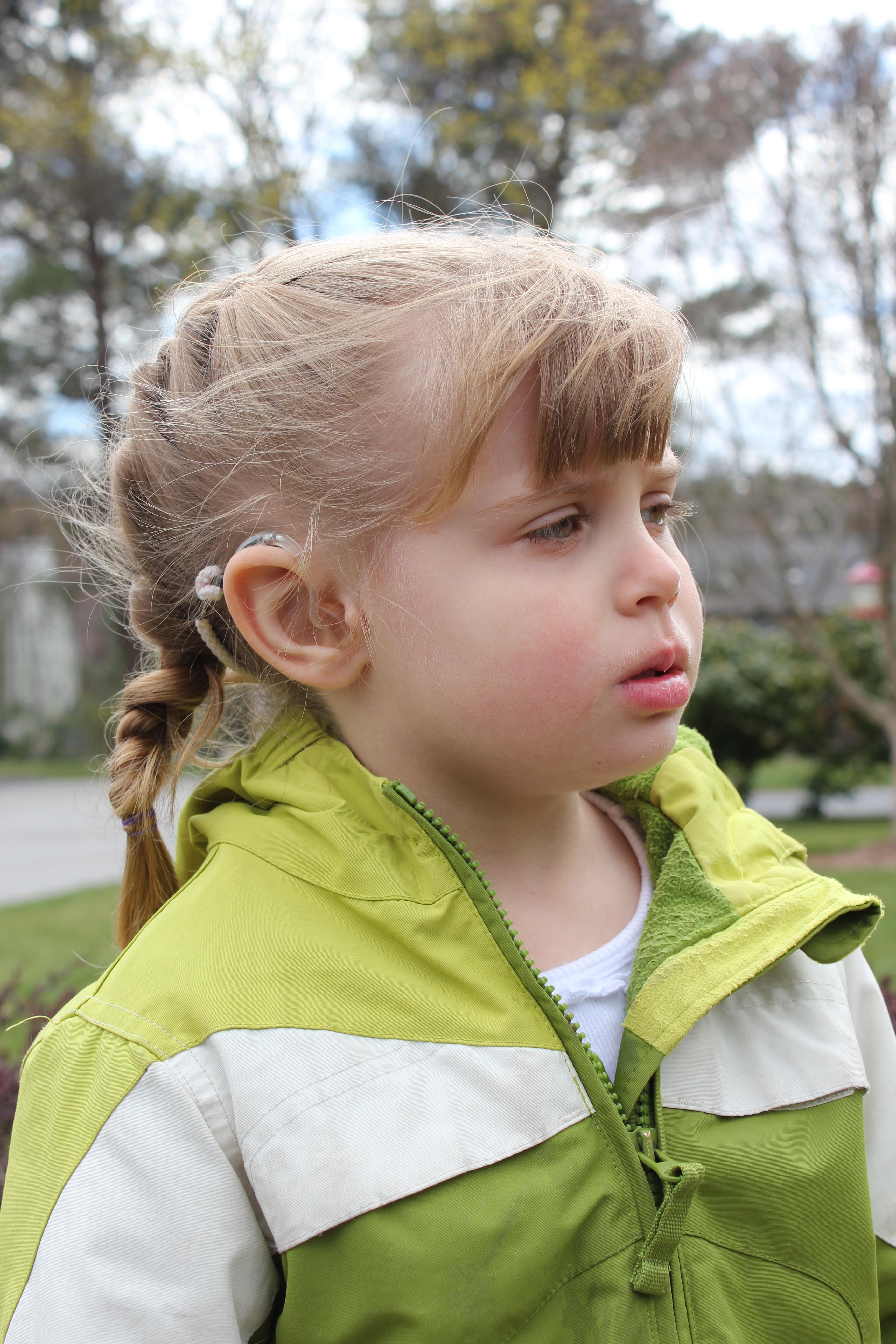
Finally, at the age of four, Sarah met the person who would change her life – the doctor who discovered that Sarah was deaf, almost.  Sarah was ‘fast-tracked’ through the medical system given her late diagnosis of Enlarged Vestibular Aqueduct Syndrome (EVA) – an unstable, inoperable condition.  Any bumps to the head could render Sarah completely deaf.

Sarah’s parents were told that she should never participate in contact sports.  No kickball games, no monkey bars at recess, no…fun?  Pass the bubble wrap, please.  And the tissues.  Family and friends cried big, ugly tears for this beautiful little girl.  For the difficulties she would endure, and for the frustrations already spent and still to come.

One day, not long after Sarah got her very first hearing aids, the tears changed shape.  When Sarah walked outside, she stopped at the top step, wide-eyed and incredulous at the sounds she was hearing.  She jumped – startled by a crow.  “What’s that?” she asked.  She had never heard a bird before.  When Sarah went to bed, instead of crying, she was able to communicate her fears.  “I need the light.  I’m scared.”  And she lay down peacefully, hearing the comforting words of her parents. Sarah doesn’t act out like she used to.  She stills herself so she can read lips and enunciate the words she is learning.  And she sings. She sings!

Sarah and her family are preparing for the future.  They are learning sign language.  They are gathering resources and information.  And they are basking in the sound of each other’s voices.

One day, in mock posturing, Sarah said to her family, “You’re. Not. LISTENING!”  The same words that had been mistakenly directed at her for years.  With regret for their ignorance, they stopped what they were doing and faced the beautiful little girl with the hearing aids.  “Tell us, Sarah.  What do you want us to hear?”  To which she said nothing.  She stared at them in silence, content that finally, people could hear her.  And she could hear them.

“All the sounds of the earth are like music.”  – Oscar Hammerstein

Listen well.

Excerpted from an article by Donna R., Sarah’s mother, and my sister

Saving Seven Lives

I’m drowning in thoughts of murder.  No, not  me.  I don’t want to murder anyone – today.  But it seems that plenty of people do.  Which makes me wonder, like the Black Eyed Peas do in their song, ‘Where Is the Love?’

I’ve been reading the Hunger Games trilogy in which murder is a main theme.  Then there’s the daily disturbing news coverage of murders like the one of the man who killed seven people.  Couple this with the re-telling of the Passion of Christ this Easter season in which the crowd shouts, “Crucify Him!” and you understand how I got to this unsettled place.  Still, I surprised even myself when I burst into tears at Mass.  My children, unaccustomed to Mom crying, giggled nervously and whispered to each other loudly enough to draw attention to my spontaneous unraveling.

An explanation was expected on the ride home.  But how to articulate my despair?  Is it wise to expose my children to my darkest thoughts?  Mother is supposed to be a beacon of hope and strength and comfort.  Yet, she is human and desires that her children witness that truth. 

So she begins, delicately, trusting that her children will rise to the challenge before them.  She tells them that she feels weak sometimes and powerless against the evil in the world.  And when she stands before God in His house and spills her heart out to Him, she feels like a child who needs to cry about what she can’t do and can’t have – like world peace and safety for everyone.  Mother chokes up again when she proclaims how unfair it is that a person can decide to kill seven people and just do it.  But another person, like Mother, can’t decide to save seven people .  It’s easier, it seems, to kill people – literally and figuratively – than it is to save them.

The children, desperate to patch up Mother’s wound as she has done so many times for them, offer their wisdom.  The son, usually silent, speaks first.  With his story, the son pulls the mother’s pain out of her in the same way that Androcles plucked a festering splinter from the lion.  Here is what he said:

“Once there was a boy who was walking home from school.  Some bullies gave him a hard time and all his books spilled out of his backpack.  Another boy saw this and came to his aid, picking up books and helping the boy up.  The Samaritan asked, ‘Why are you carrying so many books?’  The boy answered, ‘I cleaned out my locker because I had intended to kill myself today.  I’m sick of being bullied.  I thought no one cared about me.  But you helped me.  And now I know I was wrong.  Thank you.'”

By the end of her son’s story, Mother is crying again, but for a different reason.  She is humbled by her son’s wisdom and compassion.  She feels hope and joy in his story.  Fearing that Mother may have missed the point, the son explains, “You never know the effect that kindness has on people.  You’ve probably saved a lot of lives, Mom.”

…..

There are moments in life when my heart fills so unexpectedly and so completely that I wonder how it remains contained in my chest.  The heart that only moments before was shriveling in despair, is renewed by an extended hand of compassion.  In an instant, I am transformed like the Grinch on Christmas morning: 

And what happened then?  Well, in Whoville they say that the Grinch’s small heart grew three sizes that day.  And then the true meaning of Christmas came through and the Grinch found the strength of ten Grinches plus two!

A little love from little beings brings big love to big beings.  Beautiful.

.

A Female Prerogative

If I had a dime for every time someone has described my little girl as ‘sweet,’ I’d be able to pay for her college tuition.  She owns sweetness.  But there are moments when sweet turns salty.

Return with me to a scene in my kitchen seven months ago….Eight year old daughter is throwing a tantrum worthy of a Terrible Two.  She slings accusations of treason, threats of mutiny, and plenty of parent bashing.  My crime: signing her up to play fall Lacrosse.  By the magnitude of her reaction, you’d think I’d told her she was committed to prison or to an orphange.

In my most delicate and patient Mama voice, I reminded Miss Sweetness that I signed her up for this session months before – when she was enjoying lacrosse.  “But I DON’T love it now and I WON’T do it and you CAN’T make me and….” screamed the angel with her halo on fire.  The tension escalated when I told her definitively that she would be honoring her committment to the team – i.e. I’m not throwing away hundreds of dollars in fees.  BUT, no worries, Peach, I wouldn’t think of signing you up again after this season.  You’ve made your wishes clear.

Periodically, the tantrums replayed themselves.  Each time, husband facetiously pointed out, “We’re gonna miss this.”  When emails reminded me to sign up for the upcoming lacrosse season, I confidently hit delete, delete, delete.

Enter Peach on the opening day of Spring lacrosse.  “Mom?  I was talking to my friends today and decided I want to play lacrosse.”

Silence.

More silence.

I was livid.  And speechless – which turns out to be a very lucky (and uncommon) thing.  Lucky because I’m certain I would have regretted a word or two.  Visualize me, if you will, a cartoon character – face beet red, steam shooting out of its ears.  A multi-dimensional “Oh?!#$%” escapes my lips.  “Yes,” she replied guiltlessly.  “And I’ll need a new mouthguard and shorts.”  Off she skipped, blissfully ignorant of the fury rising within me.  Admidst the brew of poisonous thoughts in my head, a glimmer of admiration popped up.  Imagine, after what she put me through, she has the nerve to declare that she simply ‘has changed her mind.’

How frequently I’ve commiserated with girlfriends who refuse to change their mind or admit a wrong choice for fear of inconveniencing or angering another.  Why, and when, do we lose the courage to speak our truth without fretting over what others will think?  Might it be best, then, to honor this courage in a young girl instead of stamping out the fire with a vengeful reaction?

I coach myself against the desire to make my little tigress suffer in kind for previous infringements on my sanity.  Still, I reach deep in my pockets for a reason to deny  her new whim.  I even consider how she will compensate me for the late fee I’ll incur.  (I can hear Yoda assessing me, ‘The need for justice is strong in this one.’ )

Failing to justify the need to reap revenge for revenge’s sake, I return to the fact that my daughter is just 8.  I can’t hold that against her.   In fact, I can learn from her.  I just hope I can muster her level of courage when I need it.  If I’ve made a committment to you, be forewarned, I may change my mind simply for the practice.

Thank You, Button

Sometimes the world is so beautiful I can’t stand it.  More accurately, the world is always beautiful, and sometimes I see just how mignificnet it is and it blows my mind.

I conducted an experiment one day, challenging myself to find the smallest, most insignificant thing I could feel grateful for.  My attention shifted to the buttons on my shirt.  Boring, commonplace, underappreciated buttons.  As I focused on them, I saw how simple they were, a no-brainer as far as inventions go.  Yet buttons didn’t always exist.  Imagine the first person to discover buttons.  He/she was probably elated at this newfound convenience.  A decorative one to boot! 

Then I pictured my shirt missing a button.  Gee, I’m glad I’m not missing a button.  You know, I actually have hundreds of buttons, and they’re all different!  So I went to look at those buttons too.  In my closet, I ran into belts and zippers and all sorts of fabrics and colors and designs.  Then I notcied the light above my head and the simple switch that turned on this amazing technology.  And I was grateful for Thomas Edison and…..

Like a runaway train, gratitude gathered momentum within me.  It sped down the track of my mind out of control.  I couldn’t stop seeing everything as amazing.  I actually had to look away – turn my brain off – for fear that it would crash.

There are days that I repeat this experiment just for the trhill – like a hyped-up child who gets off a rollercoaster and runs right back into the line to ride again.  I’m addicted to gratitude high.

The irony is, the more I see that everything matters, the more I realize that nothing does.  In gratitude-speak, the fact that I have a chair to sit on is magnificent.  The loss of that chair would be grand, too, because the floor would be there for me to sit on.    And if I didn’t have the floor, well, the ground would support me and I would be grateful for that.  And there it goes again – gratitude taking off with me in tow until I start crying because I can’t fathom the abundance in front of me, and below me, and beside me.

Mark Haddon’s autistic character in The Curious Incident Of The Dog In The Night-time observes, “I think there are so many things in just one house that it would take years to think about all of them properly.  And also, a thing is interesting because of thinking about it and not because of it being new.”

It sounds silly, but I am grateful to gratitude for showing me how to think about things ‘properly.’  And for coloring my world with so much overwhelming beauty.

I. Need. Help.

(Dedicated to ShaZam)

In my twenties, I practiced extreme independence and self-sufficiency.  I didn’t need anyone.  I could handle myself, thank-you-very-much.  From changing the oil in my car, to teaching myself how to sew, there was nothing I wouldn’t take on.

This fierce ‘hear me roar’ persona is one of the qualities that attracted my husband, I’m told.  Looking back, I must have appeared to be quite a catch – a girl who wants to be with a man but has no intention of depending on him.  Husband, bless his thick skin, wasn’t even put off by my frequent declarations of independence.  Me: “I don’t need you, you know.”  Husband: “Yes, dear.  You’ve made that clear.”

To my husband’s amusement, I would throw my 110 pounds into impossible tasks like loosening lug nuts on a tire or carrying roofing shingles up a ladder, refusing to accept help.  He only offered unsolicited help once.  His genuine concern over my safety was met with a Hulk-like reaction.  I didn’t quite sprout muscles or turn green, but my voice did deepen as I spit venom in my husband’s direction.

It’s comical now – my staunch opposition to assistance.   I naively equated dependence with weakness.  My black and white thinking saw no middle ground between complete independence and helplessness.  I wouldn’t let anyone help me for fear that I would be surrendering my power to them.

This supremely invulnerable alter ego continued into motherhood.  I tried to do it all – with a smile.  When number two baby came along seventeen months after number one,  and husband left for a business trip one week later, I finally fell off the scaffolding.  Cradling a colicky baby and a screaming toddler I cried into the phone, “I can’t do it.  I. Need. Help.” …..and the walls of the city crumbled.

The image of invincibility that I had built up was, ironically, as delicate as glass.  What looked like strength was actually weakness.   An attempt to cover up fear.

These days, I hand my husband a jar before I try to open it.  I take my car to the mechanic for an oil change.  I ask a child for help with the computer.   And yet, I feel stronger than ever.

I’ve learned that I do need people to help me through life.  And they need me.  We are inter-dependent.  Us people, we are gifts to each other.  When we wall ourselves off, we do so at our own peril.  And we rob each other of the gift of being able to help.

I still pride myself on my ability to care for myself.  I like being independent.  But I also enjoy knowing that I can ask for, and accept, the love and kindness that others have to give.

Calendars, Cops, and Country Singers

When my online calendar gave me the following alert, “Caution!  There are conflicts in your schedule.” I paused, briefly.  No kidding, I thought.  Two working parents, three kids in sports, an aging dog, doctors and dentists appointments for all….There are bound to be a few conflicts in the schedule.  Until I figure out how to invent time or bi-locate, those conflicts are going to have to learn to co-exist.

This week marked the beginning of a mind-numbing schedule full of activities and appointments that are all essential (according to their participants.)  I sometimes envision my online calendar with a life of its own – like the 1970s sci-fi movies about smart computers taking over humanity.  It appears as if I enter one item and it magically multiplies until the once neat white/gray grid is eclipsed in a wall of red.

Joking aside, I’m well-aware of my responsibility in creating this mess.  I’ve given too many yes’ and not enough no’s – clearly.  But like many things in life, if you think too much about decisions before making them, you get stuck in the details and never move forward.  So, I say yes without having any idea how I will manage the details.  A clever man – aka husband – once said, “we’ll never be able  to afford kids on paper but somehow it all works out.”  So far, he’s right.

Darryl Worley advises,

Sounds like life to me plain old destiny

You gotta hold on tight just enjoy the ride

Get used to all this unpredictability

Sounds like life.

I’ve surrendered to this somewhat comforting outlook on life.  Which is why, when asked to be a home-stay volunteer for an out-of-town student group this weekend, I gave a sincere ‘yes.’  Might be fun – after the extra cleaning, (i.e. gutting and fumigating a child’s bedroom), food shopping, and juggling of carpools.

So why take on so much?  Truth is, I love being busy.  The ‘busy’ reminds me that I am abundant.  I am needed.   Taylor Swift points out, “Life makes love look hard.”  Love takes work and patience and time.  But someday, when I look at my kids’ healthy, straight teeth, I’ll forget the umpteen trips to the orthodontist and the endless arguments about brushing and flossing.  When I hear them tell stories about the time they scored a goal or broke a bone, I’ll forget the rushing around from one sports field to the next.    I’m willing to bet that Trace Adkins is correct in predicting, “I’m gonna miss this.” 

For now, I have to keep a sense of humor and hope that those around me will do the same.  Like when the police officer pulled me over and asked, “Ma’am, do you know how fast you were going?” I replied with a definitive, “Yes, I do.  Very fast.  Would you like to see my calendar?”

Next Newer Entries